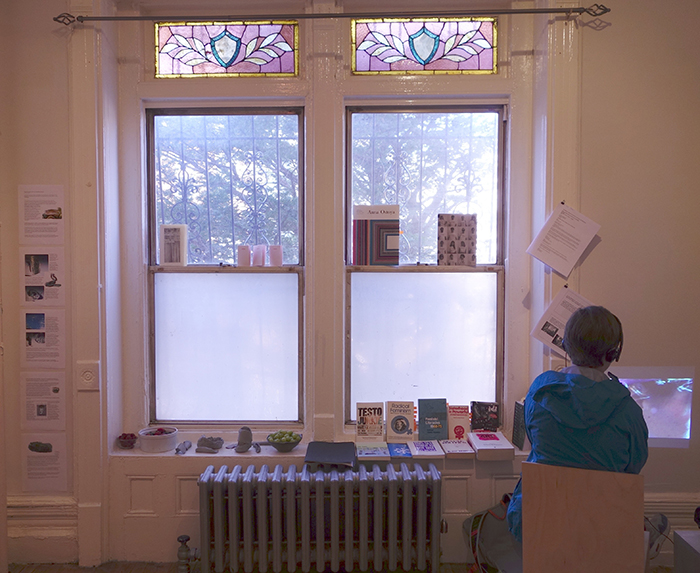
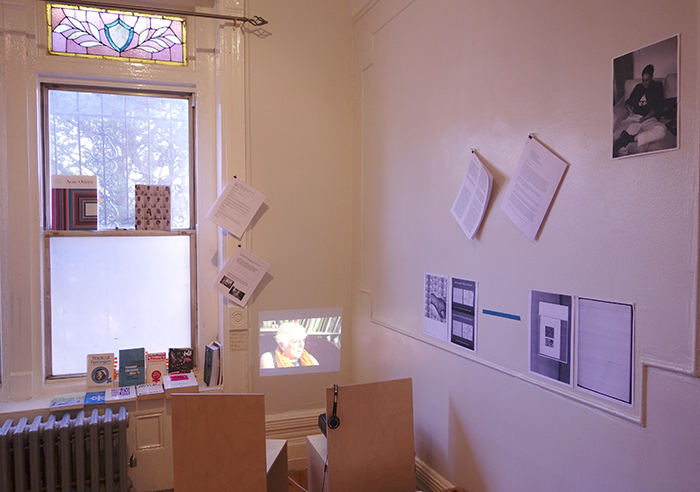
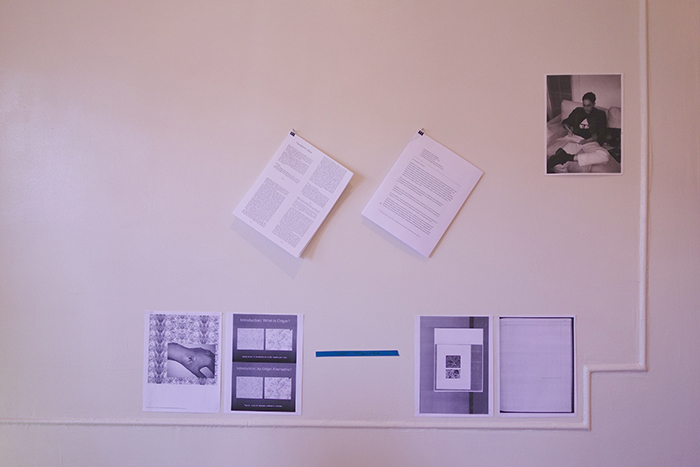
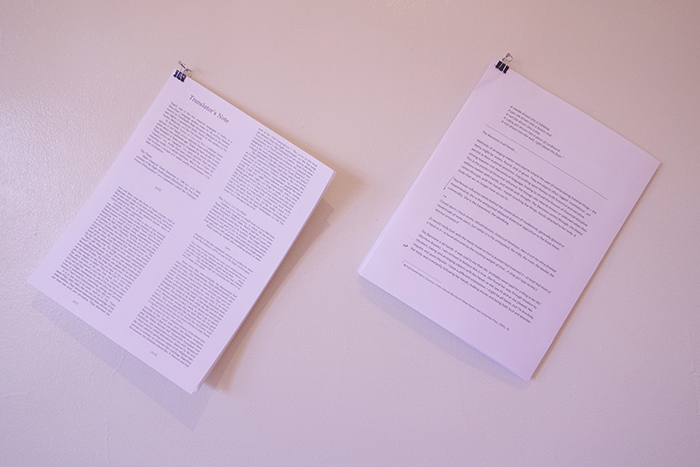
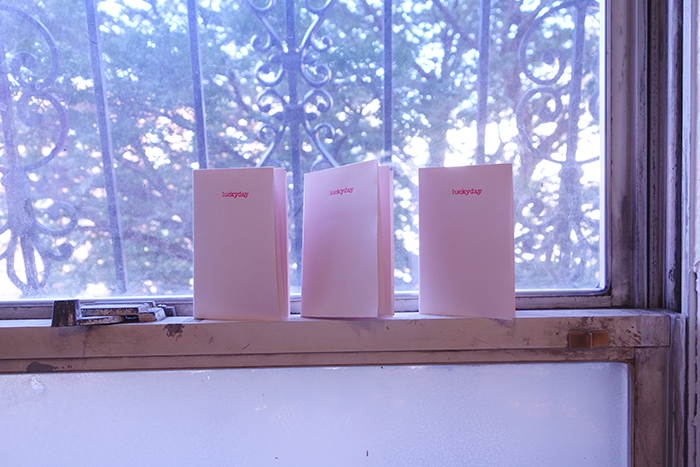
Odradek, Les Instants Chavirés, vue de l'exposition, Montreuil, Fr, 2015. Photo : Aurélien Mole
Odradek, Les Instants Chavirés, vue de l'exposition, Montreuil, Fr, 2015. Photo : Aurélien Mole
Odradek, Les Instants Chavirés, vue de l'exposition, Montreuil, Fr, 2015. Photo : Aurélien Mole
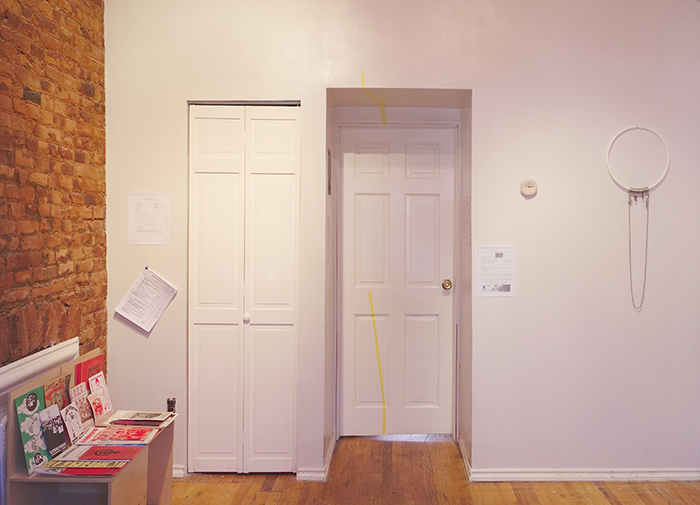
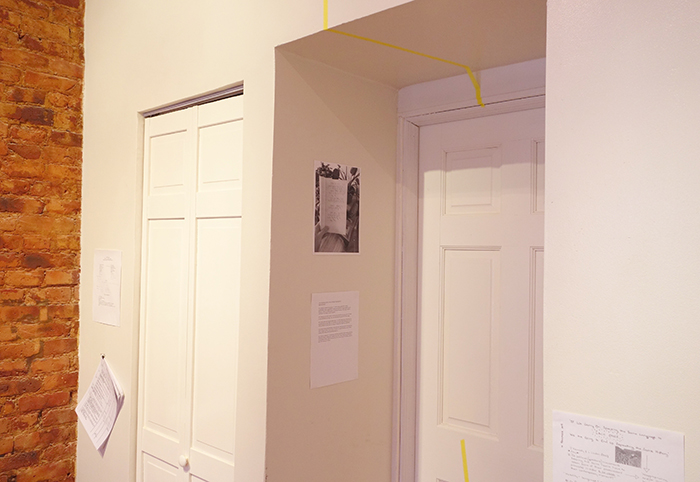
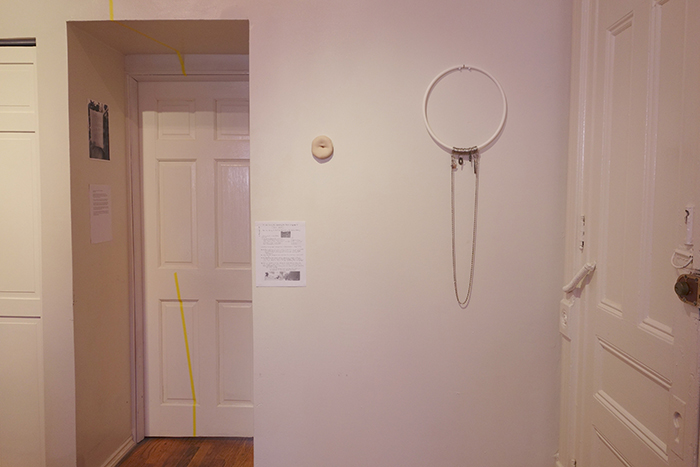
De gauche à droite : Antonio Contador, FPMB, 2015, impression numérique sur papier Hahnemühle.Maxime Bichon & Paul Maheke, Ask for trouble, 2015. Impression jet d’encre sur tissu. Celia Hempton, Putty, 2015. Peintures à l’huile, chaine en céramique, teinture sur soie. Photo : Aurélien Mole.
Celia Hempton, Putty, 2015. Peintures à l’huile, chaine, teinture sur soie. Photo : Aurélien Mole
Odradek, Les Instants Chavirés, vue de l'exposition, Montreuil, Fr, 2015. Photo : Aurélien Mole
Odradek, Les Instants Chavirés, vue de l'exposition, Montreuil, Fr, 2015. Photo : Aurélien Mole
Mathis Collins, Un atelier de peinture au doigt, 2015. Tirage jet d’encre sur aluminium, bois, acrylique, vernis, doigtiers. Photo : Aurélien Mole
Valentina Traïanova, Shlap, 2013. Installation sonore. 11 min 27. Sans titre (flaque), 2010. Série de 111 flaques ratées. Encre de Chine sur papier. Photo : Aurélien Mole
Odradek, Les Instants Chavirés, vue de l'exposition, Montreuil, Fr, 2015. Photo : Aurélien Mole
Bianca Bondi, Eunuch, Installation in situ, latex, peinture acrylique, cuir, sable et objets divers. Photo : Aurélien Mole
Bianca Bondi, Eunuch, Installation in situ, latex, peinture acrylique, cuir, sable et objets divers. Photo : Aurélien Mole
Odradek, Les Instants Chavirés, vue de l'exposition, Montreuil, Fr, 2015. Photo : Aurélien Mole
Clémence Roudil, Ce qu’il en reste : groupe Paris #2, 03.03.15, Enregistré lors du séminaire “Pourquoi des concepts ?” à l’ENSBA, Paris. Extraits du chapitre 14 : le lisse et le strié de "Mille Plateaux", Gilles Deleuze, Felix Guattari. Ce qu’il en reste : groupe Londres #3, 19.04.15, Enregistré au Castle of Astbury, Peckham, Londres. Extraits de "King Kong Theory", Virginie Despentes, traduction de Stéphanie Benson, 2015. Enregistrements sonores. Photo : Aurélien Mole
Paul Maheke, Mutual Survival,Lorde’s Manifesto, 2015. Diptyque vidéo présenté sur écrans.Photo : Aurélien Mole
Julie Béna, Rose Pantopon, the novel, Stories in Greece (with BB),2015, impression sur tissu. Courtesy the artist and gallery Joseph Tang. Barbara Sirieix, Letters to Rose,Stories in Greece (texte : Barbara Sirieix, voix : Barbara Sirieix, Julie Béna, arrangements : Julie Béna),2015. Enregistrement sonore. Photo : Aurélien Mole
Emilie Jouvet, At the window, Paris, 2011. Red wine, Paris, 2011. Blood, Paris, 2013. Photographies. Photo : Aurélien Mole
Mathilde Veyrunes, The Run, 2015. Film, 16 min 7.Photo : Aurélien Mole
Dans le cadre de l'exposition "Odradek" ___@__, les Instants Chavirés se réjouissent de vous accueillir pour une première soirée de performances qui présentera les nouvelles productions de Antoine Dufeu &Valentina Traïanova, Violaine Lochu et Sébastien Rémy, toutes écrites en réponse aux projets “Si nous continuons à nous parler le même langage, nous allons reproduire la même histoire” et “Odradek"
Les Instants Chavirés, 19h00 - 21h30 2, rue Emile Zola, Montreuil
___@__ Antoine Dufeu & Valentina Traïanova, "Katran"
Entre récit narratif, danse et improvisation sonore, la nouvelle performance de Valentina Traïanova et d'Antoine Dufeu intitulée Katran (qui signifie "goudron" en langue bulgare) met en scène des personnages dont les identités sont mouvantes. Elles y sont corrélées aux lieux, aux climats, aux paysages, aux ambiances mais aussi aux langues parlées ou encore aux conditions socio-politiques qui les affectent. Cette performance s'inscrit dans le prolongement d'une série de propositions pensées pour une patineuse-chanteuse et un lecteur.
Remerciements aux Laboratoires d'Aubervilliers.
Antoine Dufeu et Valentina Traïanova collaborent depuis 2008, leurs productions génèrent l'entité Lubovda.
Valentina Traïanova est artiste et performeuse. Née à Sofia, elle vit à Paris. Elle est arrivée en France en 1996, à Nice, où elle se fit passer pour une championne de planche à voile avant d’y poursuivre ses études. Elle est diplômée de l'E.P.I.A.R. Villa Arson et de l'Académie Jules Pasquin de Sofia. Son travail a notamment été présenté: à La maison rouge - fondation Antoine de Galbert, au Palais de Tokyo, au cneai =, aux Laboratoires d’Aubervilliers, à Bétonsalon, au Centre Pompidou-Metz, au MUDAM (Luxembourg), à l’UBA et à The Fridge (Sofia, Bulgarie), au Mac/Val. Diplômé de l'edhec, Antoine Dufeu est écrivain, éditeur, curateur, journaliste et enseignant. Auteur d'une vingtaine d'ouvrages, ses textes sont joués en France et à l'étranger. Il est directeur du programme de recherche Valuations (Ecole nationale supérieur d'art de Nancy, cneai = ...) et de Lic. Il est responsable du pôle "écriture" de l'école de design Strate et membre du comité de rédaction de la revue Multitudes. Dernier ouvrage paru: Sic (al dante, juin 2015).
___@__Violaine Lochu, "T(H)RACES"
À partir des lectures croisées de textes anciens et contemporains, dont notamment, Histoires d’Hérodote (V e siècle avant J. C) et Ce sexe qui n’en est pas un, de Luce Irigaray (1977), où sont abordées les questions des genres et du langage, Violaine Lochu « ré-invente » la langue du peuple semi-mythique des amazones. En se basant sur des études de la linguiste féministe, l’artiste applique à des fragments linguistiques existants a priori disparates (chants traditionnels ukrainiens et inuits, structure grammaticale japonaise, inscriptions thraces…), les protocoles d’un langage non phallocrate.
La voix, en cherchant des trajectoires au sens propre inouïes – tactiles, plurielles, circulaires… – explore la possibilité d’un « devenir-femme » du langage.
Violaine Lochu est née en 1987, elle vit et travaille à Montreuil. Diplômée de l’école nationale supérieure d’art de Paris Cergy) et d’un Master II recherche arts plastiques (Université Rennes 2), Violaine Lochu a exposé et performé en France et à l’étranger (la Friche la Belle de Mai, le Générateur, Betonsalon, Les Bouffes du Nord, Le Cirque Electrique, la Marbrerie, Espace 13, galerie Justina M.Barnicke à Toronto, North End Studio à Détroit…) et a été accueillie en résidence au 116, à Mains d’œuvres, au Générateur, à La Box.
___@__Sébastien Rémy, "Nameless Series"
Enquête digressive et récit de voyage, le projet "Nameless Series" vise à suivre les traces de l'artiste américaine Lee Lozano à partir d’un voyage entrepris par Sébastien Rémy à travers les Etats-Unis au printemps 2015. "Nameless Series" entremêle la quête identitaire menée par Lozano à une constellation d'identités versatiles et mouvantes. Pour ce dernier opus, Sébastien Rémy présentera une performance où se croiseront différentes voix, textures et langages à partir d’images, de sons et de textes qui seront le résultat de son séjour à New York, Dallas et Los Angeles. Mêlant autofiction, enquête, récit de voyage et spéculation, Sébastien Rémy réactive les fantômes de Lee Lozano pour une traversée dans une zone instable et poétique.
"Nameless Series" a reçu le soutien des services culturels de l’Ambassade de France aux Etats-Unis. Sébastien Rémy est né en 1983, il vit et travaille à Paris. Diplômé de l’école nationale supérieure d’art de Paris Cergy, Sébastien Remy a exposé en France et à l’étranger. Parmi ses derniers projets figurent « A Company That Makes Everything » (Villa Arson, 2014), « La Vie domestique », (Parc Saint Léger, 2014), « Le Nouveau festival » (Centre Pompidou, 2014), « Les sons du silence / The Sounds of Silence » (Centre d’art contemporain La Halle des bouchers, 2014), « L’apparition des images » (Fondation d’entreprise Ricard, 2013).
" Etre un c’est trop peu, et deux n’est qu’une possibilité parmi d’autres.
Odradek respirexpire des rêves, des images, des flux, de la relation, des forces, de la vapeur-vie incarnée. El doute de sa propre identité. Circé marabout - bout de ficelle, Odradek est un nous mouvant tissé des fils de chacun. Chaque seconde, el s’invente sans jamais épuiser le sens de ses références et de ses amulettes. Judy Lozano - Lee Chicago. El puise dans l’amour pour fabriquer ses propres lexicons.
El se nourrit des passés, présents et futurs imaginés pour écrire les histoires oubliées. Dans la matière digitale, la vibration de l’organique, la liquidité des corps, Odradek opère par extension, condensation, mutation, intégration. Comme nous pénétrons en el, Odradek entre en nous. El onde, bave, code, colle, amplifie, hante, pirate, infecte, s’affecte, s’approprie, transforme et devient.
"a document from If We Carry On Speaking the Same Language to Each Other, We Are Going to End Up Repeating the Same History"*
Super 8 Film
10:38 minutes
This film is a documented trace of current research that I’m doing on immediacy. Ten people had gathered for an 8-hour discussion on undoing inherent power dynamics of assembled groups, where I could present a topic for 12 minutes. Instead of speaking, I used that time to film. I set up the super 8 camera as an instigator for disruption in the space in order to play with emotional reactivity and engage and capture relations in real-time.
With the action of filming, I wanted to generate the opportunity for interactions to be captured in real-time. Immediacy can cause instability that I find valuable. Precarity, in my opinion, is a moment for growth and difficult questions; it allows for the space of assumptions to become visible and for roots to show. In a sense, that moment of negotiation is an opportunity to explore the self through the bars of construction of societal codes. The strength of analog film is to archive the uncertainty of the present
tense, of the right now. Celluloid film is a technically precise medium
where deviation becomes perceptible. Here are some of the ways that I
imagined that the camera would ignite disruption:
- Be a spectacle,
to replicate what already exists (the act of being watched, or being
invisible) silent film, all visual representation, no voice (!!)
-
Shifting power dynamic between the camera operator and the subject
filmed what identities are being performed? How are we performing race,
class, gender?
- What gazes are we presenting? What gaze is it, if not a male gaze?
Each of the 10 people filmed for one minute. And, with 10 different untrained hands on the camera, technical errors are to be expected and invited.
For the Session 1, artist Hương Ngô presented for the first time music she had been composing under the pseudonym Tuen Mun. Inspired by filmmaker and theorist Trinh T Minh-Ha, the music triggers the vibrations of feminism and race while using the lightness of pop and rocky notes.
Functioning as a double of the score, the following images and text were composed as a collage on one sheet of paper and was distributed to the group during the night of the session.
I first want to thank Flora and Mikaela for the opportunity to be here tonight. I was really intrigued by the call for participation and am really looking forward to everyone’s offerings.
Tonight, I intend to explore the potentials of fandom as a model for feminism. I’ll talk about my relationship to fandom; sketch a working definition of fandom and give some examples; and talk about how aspects of this could be productive for thinking about feminist community.
It’s a notion that’s been kicking around my head for a while now, and If We Carry On Speaking… has given me the space to begin to work through it in a meaningful way. Which is great, but also fucking terrifying. Because it’s so… close. Being a fan is a huge part of my identity and being a part of a community of fans at a formative age is probably the single most important factor shaping my practice as an art worker today.
But it’s also deeply embarrassing to tell a group of strangers how indie rock saved your young life. And… I suppose I’m very conscious of the boundary between confession and candor, between honesty-as-burden and honesty-as-gift.
But because being a fan and fandom, it’s so close, I think I have a bit of trouble seeing the forest for the trees. So I need you all, I need your perspectives to try to untangle these threads of thinking. Thus, I will persevere through embarrassment to enlightenment.
I guess I should begin at the beginning. I was born in the States but I grew up in the suburbs of Halifax, Nova Scotia.
You probably went there on holiday once, and I’m sure you found it very charming.
A have-not province jutting out into the Atlantic has to finds ways to entertain itself. The 90s in Halifax saw a flourishing of independent rock music. People called it “Seattle of the North.” My feeling on that is best summed up by a Lisa Simpson quote: Anything that’s the “something” of the “something” isn’t really the “anything” of “anything”.
I caught the bug the way most people do, through a cool older sister. My best friend, Matt, his sister Nicole started feeding him tapes, and Matt passed them on to me. At 13, we began attending as many all-ages shows we could convince his parents to drive us to, at Café Ole, Birdland, the Marquee Club, the Khyber, and elsewhere.
In those rickety venues, swaying my body to jangly pop music, I saw, for the first time, a viable alternative to the suburban wasteland existence. This is a moment in my life where I was being spat on and called a dyke for – as far as I understand it – having a shaved head and high IQ. Where everyday, I was being told in one way or another that I was wrong, the things I wanted were wrong, more than wrong, they were impossible. In music communities in Halifax, first in rock and roll and later in electronic music, I encountered both a profound sense of recognition and affirmation of my desires. Here I found more palatable models of gender and interpersonal relations based on dynamic intellectual exchanges.
In the past few years I’ve realized how much these early experienced have directly shaped how I think about art and what it does. I mean, yeah, almost ten years in post-secondary institutions and varied hands-on professional experience comes into play, too. But I am still so fascinated by how we gather around artworks, how our bodies engage with them in speculative space, the forms of non-knowledge they produce, and the new identities and alliances that can form. The way that things and the love we direct at them can create new worlds. How this is a very bodily, everyday labor. How it’s a praxis.
So, if we are talking about what we can learn from fandom, I guess we should have a working definition. It’s pretty simple, in a way: a fandom is a community of fans, a subculture organized around a common interest. I think fans sometimes have an image problem: people imagine hysterical, slavish obsession with a given interest or mindless, simplistic consumption of popular culture. But within fandoms there is great diversity and productivity. Let’s think about something like fanfiction. These are stories that supplement the original story or create altogether new narratives with characters from the book or TV show or band or what have you. There is a great amount of diversity within these texts: some are straight up smut, some are novel length tales set the characters in alternative universes, and everything in between. And these spaces, these fanfiction communities, are discursively rich, there is a tremendous amount of work produced by a diverse range of authors, diverse in age, race, nationality; and no matter their differences, they all still passionately identity themselves and each other as belonging to a particular fandom.
I am really interested in these forms of imaginative resistance, the ways in which desire speaks to lack of satisfaction with the world at hand, and the ways in which we can see this as an emancipatory gesture. I like what Jane Blocker says in What the Body Cost: Desire, History, and Performance, desire “demonstrates the inability of the cultural order to fulfill its own ordering project, and reveals the difficulty with which societies control the energies desires liberate.” And I think is salient in this context of thinking about inventing new languages.
I want to look at a few examples. Constance Penley’s work is foundational in thinking about desire in fan culture. Roughly, in the text “Feminism, psychoanalysis, and the study of popular culture” from 1992, Penley looks at the Kirk/Spock or K/S fandom, which consisted at that time primarily of heterosexual, working class women who were writing pornographic fan fiction, of varying degrees of intensity. She speculates that the women are drawn to their (K/S) relationship because they treat each other as equals, and because they are drawn to the era that Star Trek emerged from, a still-hopeful 1960s America, and because of the blank slate of space, which is governed by a variety of different social structures. Still, why were these women writing the men into sadomasochistic scenarios? The thing with fantasy is that it is mobile, you can be one or both or neither, you can identify with the scene and not the actors; fantasy is about staging, not consummation. The women could identify/create a more equal and utopian world and they could indulge in power play fantasies while evading the problems of heterosexuality.
Yaoi is fascinating to me as cultural phenomena. Manga is referred to as air in Japan, because it’s just everywhere. Although its popularity has declined slightly since 1995, manga is still, without question, “one of the most extensive forms of popular culture.” The women producing amateur manga were generally lower class, with little to no post-secondary education, and with the mean age of 19 years old. Amateur manga is “one of the very few cultural and social forums in Japan… which [was] not managed by privileged and highly educated sections of society.” In 1975, the Comic Market was established by a group of young manga critics, Aniwa Jun, Harada Teruo and Yonezawa Yoshihiro, to encourage the fledgling movement. The bi-annual, weekend long Comic Market convention expanded into three day events, reaching its peak attendance between 1990-1992, with a quarter of a million attendees, making it “the largest mass public gatherin[g] in contemporary Japan.” Until 1988, approximately 80 per cent of attendees were female.
I mean, that’s huge! The desires of a marginalized group manifesting to not only create a new interpretive community, but affect the larger society as well.
But I always remember what a former professor told me, that for all my arguments I had to think of a foil. I am very aware of how subcultures can reproduce existing models/structures of inequality. We have some obvious examples: #gamergate, #fakegeekgirl, hell, even my own experiences in music, sometimes it feels like the only role for women is groupie, girlfriend, or goddess, none of which are desirable positions. Women have their fandom questioned in a way that never happens to men.
Also, you know, it’s the problem of sub-cultures: either their transgressions don’t leave a trace or they co-opted. So, I see the faults, I see the holes.
And I understand that I’ve been speaking really generally about sub-cultures that all have very particular contexts from which the emerge. But maybe this is the whole thing: if we can all see each other as fans of different stripes, fans of feminism, maybe we can create a more inclusive definition of feminism? A space for the proliferation of difference without exclusion.
Maybe this is something we can learn from. There’s this great lecture by Michael Hardt on the politics of love and evil, that you can watch on youtube, he’s at York University and it was filmed by TV Ontario, because, you know, that is what we show on TV in Canada. He says, “multitude… is a political project of the poor that is animated by love, a love that is characterized by the free experimentation with difference.”
Hardt contends that four things are required for us to animate love as a political concept:
1. "Love must be an open social concept that simultaneously applies to both the closest to and the furthest from us."
2. Love is personal and political, as much based on need as it is freely given.
3. "Love must be based on differences… love is really the experimenting with differences… creating out of difference new assemblages that in no way deny their singularities."
4. Love must be ontologically productive, love is an action, and desire is productive of community or can be; “love is not only the love of differences, but the constant production of differences."
Maybe it’s a leap, but I feel there is a resonance between what he’s saying and what happens in fandoms. And I have hope in the open, productive love of fandom, the enthusiasm and commitment. The labor of love that produces a fan community.
Utopia is no place, it is a process. And this process, this framing and reframing, I think guards against the production of static identities and intractable hierarchies. It keeps us open and responsive. If we can embrace this as a model, it will result in a richer, more diverse and ultimately more productive feminism.
But I am eager to hear your thoughts. Jacqueline Mabey is an independent curator and art worker. She participated to the Session 2 in November 2014, at PARMER, Brooklyn. Visit her website: failedprojects.net
Playlist :
1. Eric's Trip, Behind the garage
2. Sloan, Coax Me
3. The Inbreds, Any Sense of Time
4. Jale, Brother
5. Plum Tree, Dog Gone Crazy
6. Hard ship Post, Wont You Come Home
7. Local Rabbits, Sally Anns Style Denial
8. Thrush Hermit, French Inhale
9. The Super Friendz, Come Clean
10. Sloan, 500 Up
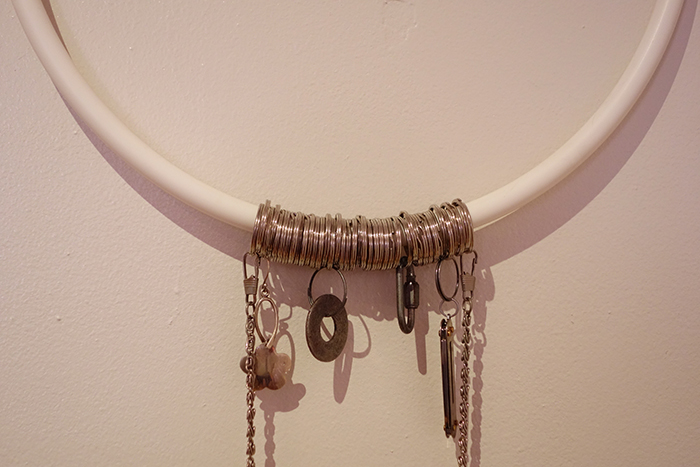
Methods of arranging matter and objects inherit the past of manipulating material things – the items might be stolen, found, and or given. They are objects often tagged ‘unambitious’, yet persist in their material presence. Expounding upon themes both historical and narrative, aiming towards non-‐hierarchical language, hoping to reveal the fissures of historical discipline. This is the poetics of historical influence, the lineage one inherits known or unknown when they address matter with hands, and words with thought. The Baroness comes through, she always comes through, with her hands – hands touching the things, hands attached to her body.
body that we no longer have access to.
This female influence exists behind the closed doors of modernism, generally ignored or misattributed, she is the antiquated debased dialectical opposition to the finish fetish commodity. She is the basement, the plumbing.
** Closed doors / back rooms.
Misattribution, historical blindness. Hers is not the shiny finished readymade of male peers, but rather it is
the antiquated, the trifle, the trash, the bauble, the "eternal ornament" (It would really fuck with the ready-‐made to find a woman had invented it – at
least had more of a hand in it – a hand obscured by the
crushing weight of time...A shop girl type no less.) -
Catherine Czacki, The Baroness is all hands, excerpt, 2014
1 Witold Gombrowicz, Cosmos, trans. Danuta Borchardt (New Haven: Yale University Press, 2005), p.79.
Catherine Czacki is an artist and a PHD student at the University of California, San Diego, in Art History, Theory & Criticism – Concentration Art Practice. She participated to the Session 2 in November 2014, at PARMER, Brooklyn. More to see on her website here
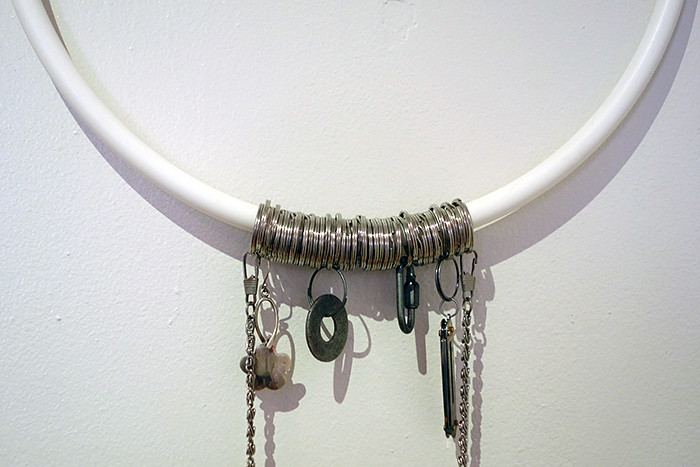
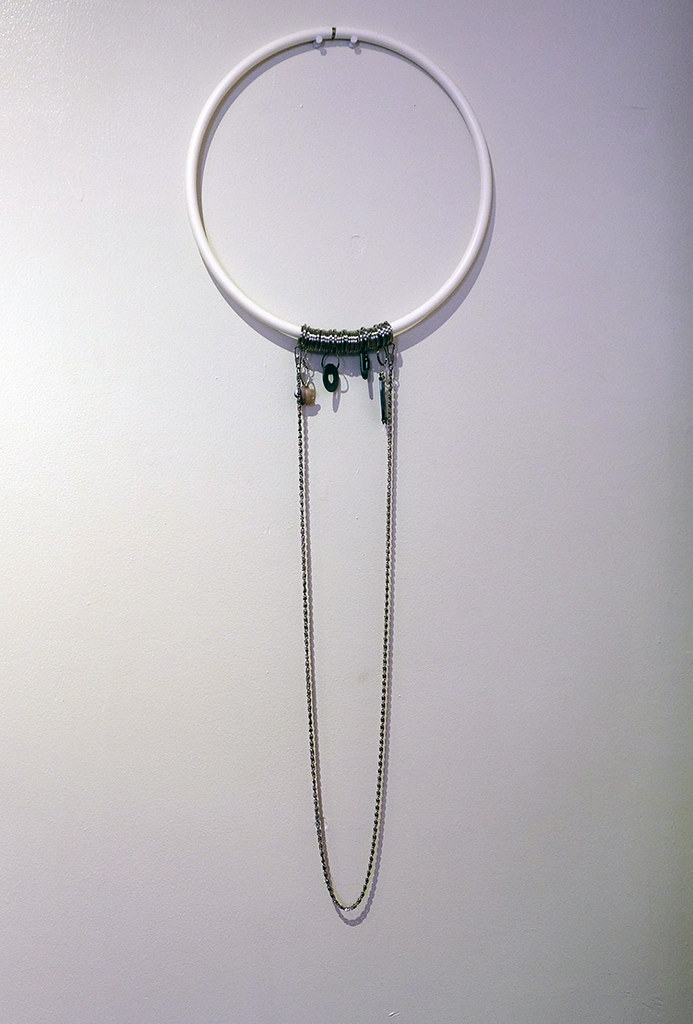
Catherine Czacki, The Baroness is all hands. PVC pipe, sharkbite, metal objects – earring, knife, washer, chain, carabiner, keyrings (found / given / stolen), 2014.
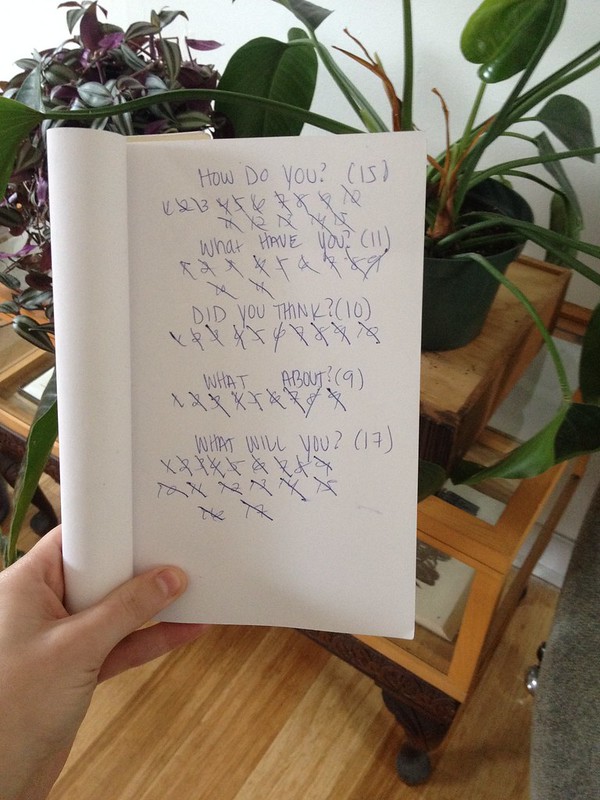
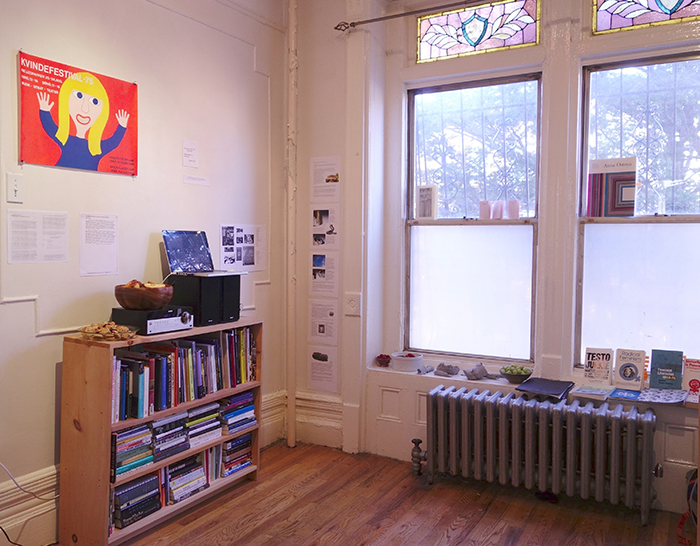
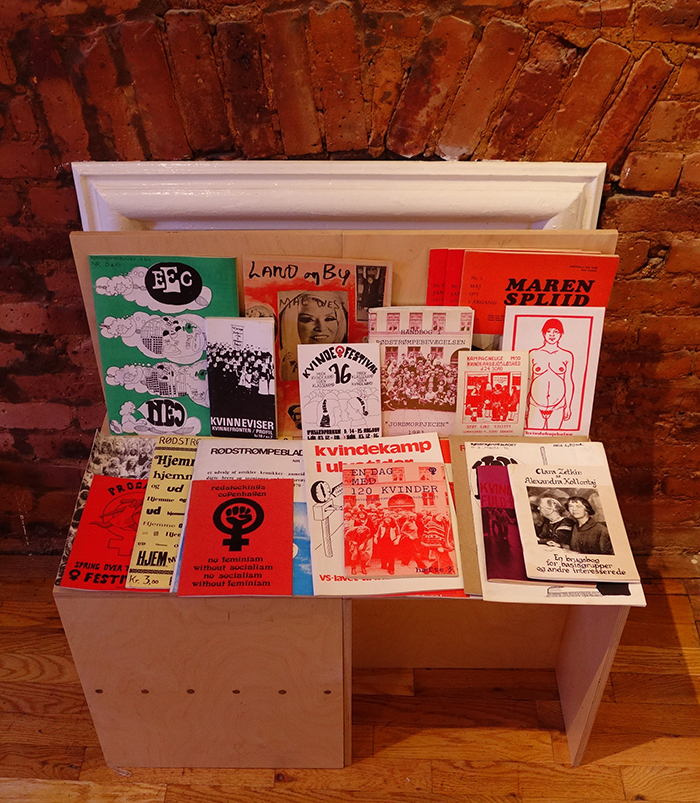
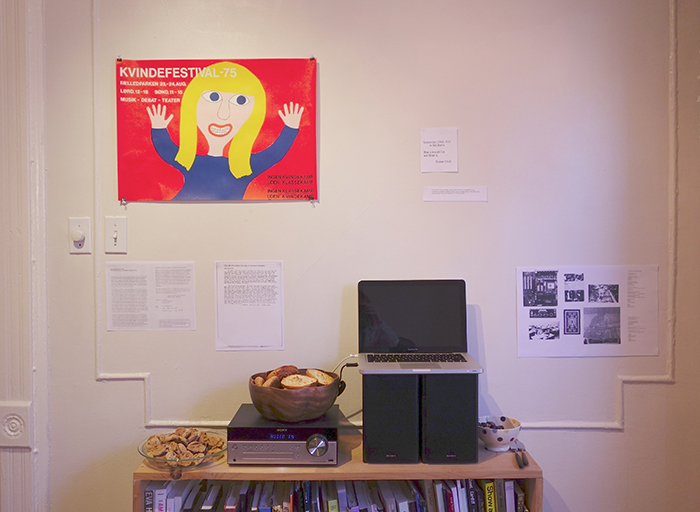
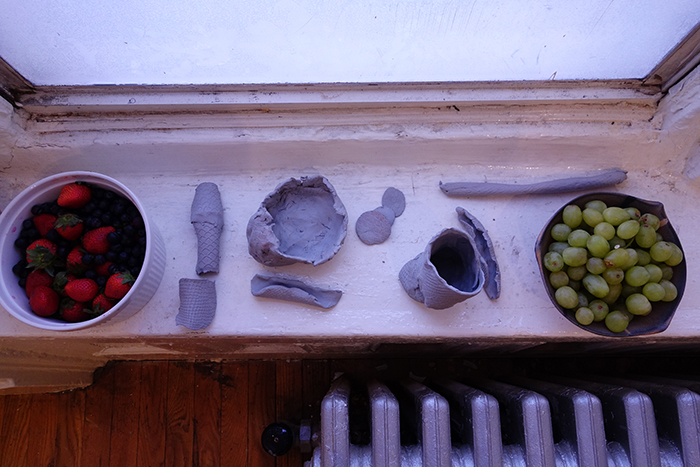
Various works, documents and objects brought or conceived, individually or collectively, by the participants along four sessions at PARMER on November 10, 15, 17 and 22, 2014. Presented on November 23, 2014 at PARMER on the occasion of a friendly public gathering.
Most of the materials will be readable in the next posts on the blog.
Participants: Arlen Austin, Amber Berson, Kylie Lockwood, Trista Mallory, Huong Ngo, Anna Ostoya, Julia Trotta, Cheyanne Turions, Lindsay Benedict, Catherine Czacki, Alaina Claire Feldman, Ariel Goldberg, Chloé Rossetti, Jacqueline Mabey, Wendy Vogel, Jane Long, Rochelle Goldberg & Sara Constantino, Rit Premnath, Maia Asshaq, Saisha Grayson, Megan Heeres & Corrie Baldauf, Maibritt Borgen, Leah DeVun & Risa Puleo, Joseph Imhauser, Liz Linden, Jordan Lord, Michala Paludan
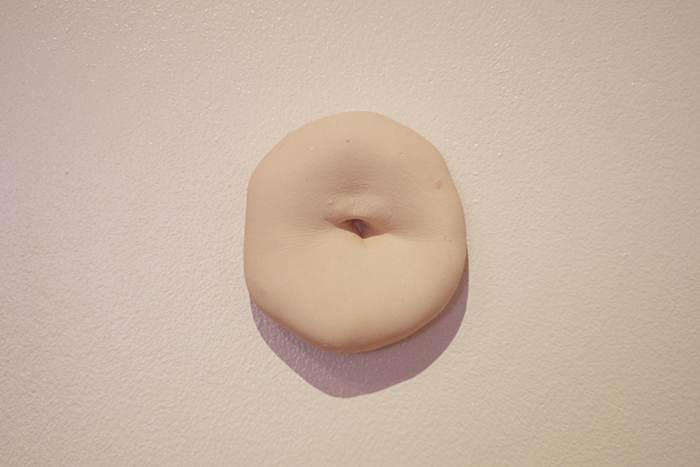
Kylie Lockwood, Cast of Navel, Pigmented porcelain, 2013
Catherine Czacki,The Baroness is all hands. PVC pipe, sharkbite, metal objects – earring, knife, washer, chain, carabiner, keyrings (found / given / stolen)., detail, 2014.